

Roof load capacity for equipment determines how much additional weight — from HVAC units, solar panels, satellite dishes, or rooftop infrastructure — your roof can safely support without risking structural damage. Most residential roofs are engineered to carry 20 pounds per square foot (PSF) of combined dead load and live load, while commercial roofs typically support 40 to 60 PSF depending on the building code and structural design. With over 20 years of roofing expertise across San Diego's residential and commercial properties, we help property owners understand their roof's weight limits before making equipment decisions. This guide covers the load types, calculation methods, and safety standards you need to evaluate before any rooftop installation.
Dead Load vs. Live Load: The Two Numbers That Matter
Dead load represents the permanent, static weight that your roof structure carries at all times — the roofing materials themselves, decking, underlayment, insulation, and any fixed mechanical systems. A standard asphalt shingle roof adds approximately 2 to 4 PSF of dead load, while concrete tile roofing adds 9 to 12 PSF. Live load represents temporary or variable forces including workers performing maintenance, accumulated rainwater, wind uplift, and in some regions, snow accumulation.
The International Building Code (IBC) establishes minimum load requirements that govern structural engineering for both residential and commercial buildings. The IBC requires a minimum live load capacity of 20 PSF for residential roofs and specifies higher thresholds for commercial structures based on occupancy type and roof access classification.
Your available capacity for additional equipment equals the total engineered load capacity minus the existing dead load and required live load reserve. If your roof was engineered for 40 PSF total, carries 10 PSF of dead load, and must maintain 20 PSF of live load reserve, you have approximately 10 PSF available for additional equipment.
Key Takeaway: Dead load is the permanent weight of roofing materials (2 to 12 PSF depending on material), live load covers temporary forces (minimum 20 PSF residential per IBC), and the difference between your roof's total capacity and these combined loads determines how much equipment weight you can safely add.
Equipment Weight Reference: Solar, HVAC, and Satellite Systems
Different rooftop equipment places varying demands on your roof's load bearing capacity. The following reference table provides typical weight ranges for common rooftop installations to help you estimate whether your roof structure can accommodate the planned addition.
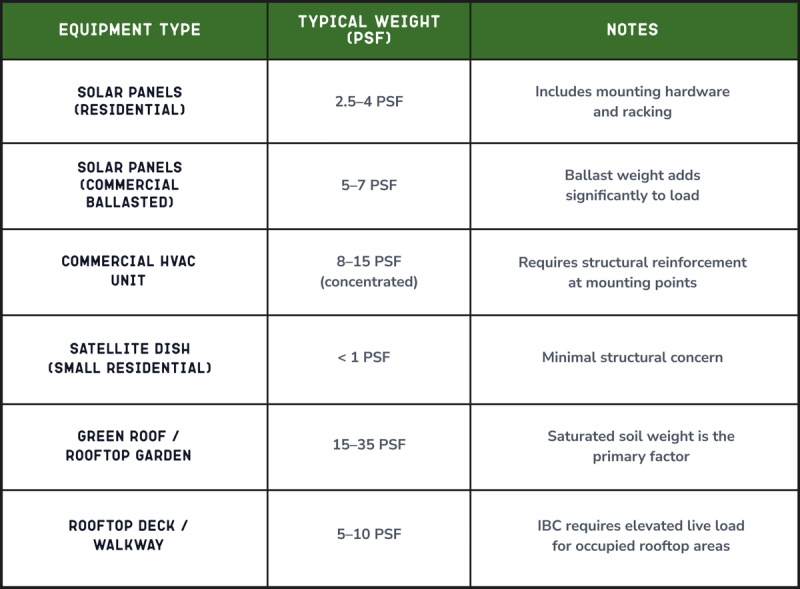
Concentrated loads from HVAC units require special attention because the weight sits on specific support points rather than distributing across the full roof area. A 400-pound HVAC unit on a 4-square-foot platform creates a 100 PSF concentrated load at that point — even if the overall roof capacity is adequate for the distributed average.
Key Takeaway: Solar panels add 2.5 to 4 PSF for residential systems and 5 to 7 PSF for commercial ballasted systems, while HVAC rooftop units create concentrated loads of 3 to 15 PSF that require structural evaluation at their specific mounting points.
When You Need a Structural Engineer
A structural engineer evaluation is required — not optional — before installing rooftop equipment that approaches or exceeds your roof's available capacity margin. As a certified Sunrun vendor, we coordinate solar re-roofing projects that protect your warranty, and we consistently advise homeowners and commercial property managers to involve a structural engineer for any installation that adds more than 3 PSF of distributed load or installs concentrated equipment weighing more than 200 pounds.
Specific situations that require a structural engineer's assessment include: adding a rooftop HVAC unit to an existing building; installing a commercial ballasted solar array; converting a flat roof to an occupied rooftop space; adding a green roof or rooftop garden; and any installation on a structure older than 30 years where the original engineering specifications may not reflect current IBC standards.
A structural engineer typically charges $500 to $2,000 for a roof load assessment, which includes reviewing the original building plans, inspecting the roof truss or rafter system, and providing a written report confirming the roof's actual capacity. This investment prevents structural failures that could cost $10,000 to $50,000 or more in emergency repairs.
Key Takeaway: A structural engineer evaluation ($500 to $2,000) is required before installing equipment that adds more than 3 PSF of distributed load or more than 200 pounds of concentrated weight — this assessment prevents structural failures costing $10,000 to $50,000 in repairs.
How to Calculate Roof Load for Your Project
Calculating roof load capacity for equipment involves three variables: the roof's total engineered capacity, the existing dead load, and the required live load reserve. The following example demonstrates the calculation for a standard residential roof considering a solar panel installation.
Example: Residential Solar Panel Installation
- Total engineered roof capacity: 40 PSF
- Existing dead load (asphalt shingles, decking, underlayment): 4 PSF
- Required live load reserve (IBC minimum): 20 PSF
- Available capacity for equipment: 40 - 4 - 20 = 16 PSF
- Solar panel system weight: 3.5 PSF
- Result: The roof can safely support the solar installation with a 12.5 PSF safety margin
For commercial roof load limits, the calculation follows the same structure but uses higher baseline values. Commercial buildings typically carry greater dead loads from built-up roofing systems, membrane assemblies, and existing mechanical infrastructure. The IBC also specifies increased live load requirements for commercial roofs based on access classification — a roof intended for maintenance access only has different requirements than a roof classified for general occupancy.
Key Takeaway: Calculate available roof load by subtracting existing dead load and required live load reserve from the total engineered capacity — a standard 40 PSF residential roof with 4 PSF of shingles and 20 PSF of live load reserve has 16 PSF available for equipment like solar panels (3.5 PSF).
IBC Minimum Standards for Roof Load Capacity
The International Building Code establishes the baseline structural requirements that all roofing and equipment installations must meet. Understanding these standards protects you from contractor shortcuts and ensures your project passes inspection.
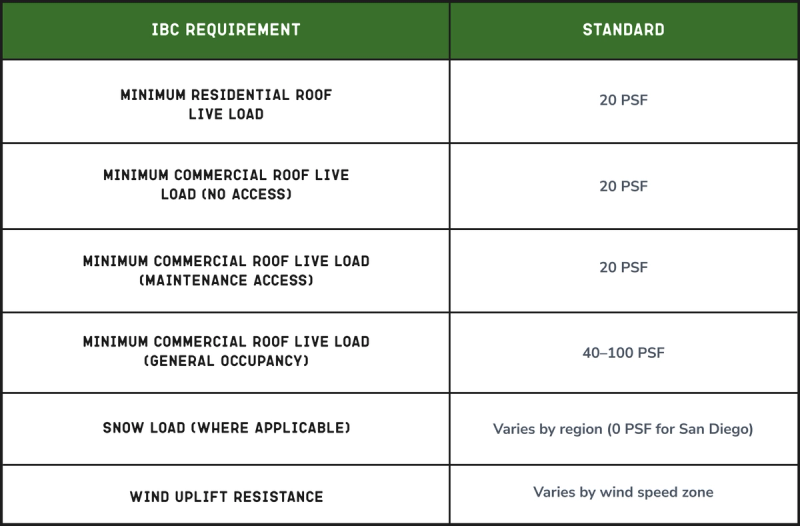
San Diego benefits from zero snow load requirements, which provides additional available capacity compared to northern regions. However, wind uplift forces in coastal areas require specific fastener patterns and attachment methods that we incorporate into every re-roofing project to meet EM-385 safety standards.
Key Takeaway: IBC requires a minimum 20 PSF live load capacity for residential roofs and 20 to 100 PSF for commercial roofs depending on access classification — San Diego's zero snow load requirement provides additional capacity for equipment installations.
Frequently Asked Questions
How much weight can a residential roof hold?
Most residential roofs are engineered for a total capacity of 30 to 40 PSF, with approximately 16 to 30 PSF available for additional loads after accounting for existing materials and the IBC-required 20 PSF live load reserve. A structural engineer can confirm your specific roof's capacity.
Do I need a structural engineer before installing solar panels?
We recommend a structural assessment for any roof older than 20 years or any commercial ballasted solar installation. Standard residential solar systems (2.5 to 4 PSF) typically fall within most roofs' available capacity, but confirmation from an engineer provides documented assurance. As a certified Sunrun vendor, we coordinate these assessments as part of our re-roofing projects.
What is the average roof load capacity?
Residential roofs typically carry 30 to 40 PSF total capacity, while commercial roofs range from 40 to 60+ PSF. Available capacity for equipment depends on existing dead load and code-required live load reserves — calculate your specific available margin before any installation.
Can a flat roof hold HVAC equipment?
Flat roofs can support HVAC equipment when the concentrated load at mounting points falls within the structural capacity. Commercial HVAC units (8 to 15 PSF concentrated) typically require reinforced support platforms to distribute weight across a larger area of the roof structure.
How do you calculate roof load?
Subtract existing dead load and required live load reserve from your roof's total engineered capacity. The remaining figure represents your available capacity for additional equipment. A structural engineer can verify the total capacity using original building plans and on-site inspection.
Get a Professional Assessment Before You Install
Understanding roof load capacity for equipment protects your investment and your family's safety. Whether you are considering solar panels, an HVAC upgrade, or commercial rooftop infrastructure, knowing your roof's actual capacity prevents costly structural failures and ensures code compliance.
We treat every roof like it protects our own family. Our team provides honest assessments rooted in 20+ years of San Diego roofing experience, with Carlos personally involved in every project. Schedule Your Free Inspection to evaluate your roof's condition and capacity before your next equipment installation.
Contact Us
Have questions or need a free estimate? Get in touch with our team today.