

The hidden costs of delaying roof replacement extend far beyond a few missing shingles — deferred maintenance can escalate a $15,000 re-roofing project into $40,000 or more in combined water damage, mold remediation, structural repairs, and emergency service premiums. Every year a compromised roof stays in place, the damage compounds beneath the surface where you cannot see it. With over 20 years of roofing experience across San Diego, we have seen firsthand how homeowners who postpone replacement end up paying two to three times the original cost. This guide breaks down the specific hidden cost categories so you can make an informed decision about your roof replacement timing.
Water Damage: The Most Expensive Silent Threat
Water intrusion from a deteriorating roof causes the most costly hidden damage because it spreads through walls, ceilings, insulation, and structural framing before visible signs appear. A single compromised area in your roofing system can allow moisture to travel along rafters and trusses, saturating drywall, rotting wood framing, and creating conditions for mold growth — all behind surfaces you cannot inspect without professional tools.
The cost of postponing roof repair becomes starkly clear when water damage reaches structural components. Drywall repair runs $300 to $800 per affected area. Insulation replacement costs $1,500 to $4,000 depending on the extent of saturation. And once water reaches your home's structural framing, wood replacement costs escalate to $5,000 to $15,000 — work that we handle entirely in-house to ensure total quality control.
Key Takeaway: Water damage from a failing roof spreads invisibly through framing and insulation, with structural wood replacement alone costing $5,000 to $15,000 — far exceeding the cost of timely re-roofing.
Mold Remediation Costs That Multiply Fast
Mold growth begins within 24 to 48 hours of sustained moisture exposure, and a roof leak provides the continuous dampness that mold requires to colonize wall cavities, attic spaces, and HVAC ductwork. Professional mold remediation for a single room averages $1,500 to $4,000. Whole-house remediation for advanced infestations reaches $10,000 to $30,000 — a cost that dwarfs most roof replacement projects.
Beyond the financial impact, mold creates health risks that make your home unsafe for your family. Respiratory issues, allergic reactions, and aggravated asthma are well-documented consequences of mold exposure. San Diego's mild climate does not eliminate mold risk — any home with trapped moisture from a compromised roof is vulnerable regardless of outdoor humidity levels.
Key Takeaway: Mold remediation from roof-related moisture costs $1,500 to $30,000 depending on severity, with growth beginning within 48 hours of sustained leak exposure — making prompt roof replacement a health investment as well as a financial one.
Structural Integrity Damage and Emergency Repair Premiums
Deferred roof maintenance costs compound when shingle deterioration progresses to structural failure. Weakened decking, rotted rafters, and compromised trusses cannot support the weight of roofing materials, creating sagging, buckling, and in severe cases, partial collapse. Structural roof repairs cost $5,000 to $20,000 on top of the replacement itself.
Emergency roof repairs carry a significant premium over planned replacements. When a storm exposes damage that has been building for years, homeowners face emergency service surcharges of 25% to 50% above standard pricing, limited contractor availability, and temporary tarping costs of $500 to $1,500 while waiting for permanent repair. We provide efficient 2-to-3-day installations with zero shortcuts — but emergency situations always cost more than planned projects with our owner, Carlos, involved from start to finish.
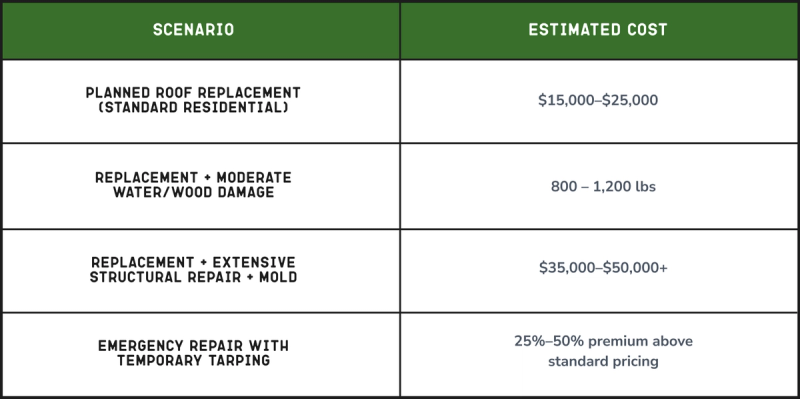
Key Takeaway: Emergency roof repairs cost 25% to 50% more than planned replacements, and structural damage from deferred maintenance adds $5,000 to $20,000 to the total project — making planned re-roofing the most cost-effective path.
Insurance Claim Denial and Coverage Gaps
Homeowners insurance may deny roof damage claims when the insurer determines that the damage resulted from deferred maintenance rather than a sudden covered event. Insurance companies increasingly use aerial imaging and inspection data to assess roof condition, and a claim filed on a roof with documented pre-existing deterioration faces a higher probability of denial.
Roof replacement timing directly affects your insurance standing. A roof past its expected service life — typically 20 to 30 years for shingles and 40 to 50 years for tile — may trigger policy non-renewal or premium increases. Some insurers require a roof inspection before issuing or renewing coverage, and a failing roof can result in coverage cancellation that leaves your home uninsured.
We provide honest pre-sale roof inspection reports that give homeowners a clear picture of their roof's condition. This documentation helps you make a proactive decision before an insurance issue forces a reactive one.
Key Takeaway: Insurance companies can deny claims on roofs with documented deferred maintenance, and a roof past its expected service life may trigger policy non-renewal — proactive replacement protects both your coverage and your investment.
Home Resale Value and Buyer Perception
A deteriorating roof reduces your home's market value by an estimated 10% to 15% and creates a major red flag during buyer inspections. Buyers and their agents view a failing roof as a negotiation point — typically requesting either a full replacement before closing or a price reduction of $10,000 to $25,000 to cover the anticipated cost.
A new roof, by contrast, delivers one of the highest returns on investment among home improvement projects. According to industry data, a new roof replacement recoups approximately 60% to 70% of its cost in added home value while eliminating the single largest buyer objection in residential real estate.
Key Takeaway: A deteriorating roof reduces home resale value by 10% to 15% and triggers buyer price reduction requests of $10,000 to $25,000, while a new roof replacement recoups 60% to 70% of its cost in added property value.
Energy Efficiency Losses You Pay for Every Month
A compromised roof with damaged or missing shingles, deteriorated underlayment, or inadequate ventilation forces your HVAC system to work harder to maintain indoor temperature. Roof-related energy efficiency losses can increase monthly utility costs by 10% to 25%, adding $300 to $900 per year to your energy bills.
Title 24 Compliant roofing materials — which California law requires for re-roofing projects — reflect more solar heat and reduce cooling demand. Upgrading to "Cool Roof" shingles that meet these energy-saving standards during your replacement turns a necessary expense into a long-term savings opportunity that pays dividends every month.
Key Takeaway: A failing roof increases annual energy costs by $300 to $900 through HVAC inefficiency, while Title 24 Compliant "Cool Roof" materials required for California re-roofing projects reduce cooling demand and lower monthly utility bills.
Frequently Asked Questions
What happens if you don't replace your roof?
Delaying replacement allows water intrusion, structural wood rot, mold growth, and shingle deterioration to compound — turning a $15,000 re-roofing project into $35,000 to $50,000 in combined repairs. We handle all wood repairs in-house to maintain total quality control, but the cost always increases with delay.
How much more does an emergency roof repair cost?
Emergency roof repairs carry a 25% to 50% premium over planned replacements due to contractor demand, temporary tarping requirements ($500 to $1,500), and expedited scheduling. Planning your re-roofing project in advance eliminates these surcharges entirely.
Can a bad roof affect your home insurance?
A deteriorating roof can result in claim denial for maintenance-related damage, premium increases, mandatory inspections, and in some cases, policy non-renewal. Insurers increasingly use aerial imaging to monitor roof condition between policy periods.
How do you know when it's time to replace your roof?
Schedule a roof inspection if your roof is over 15 years old, you see cracked or missing shingles, notice interior water stains, or find granules accumulating in gutters. We provide honest, no-pressure inspections that give you a clear assessment. Schedule Your Free Inspection to find out where your roof stands.
Does a new roof increase home value?
A new roof recoups approximately 60% to 70% of its cost in added home value and eliminates the top buyer objection in residential real estate transactions. For San Diego homeowners in neighborhoods like Otay Ranch, Eastlake, and Poway, a quality re-roof by our family-owned team protects both your home and your equity.
Make the Decision Before Your Roof Makes It for You
The hidden costs of delaying roof replacement — water damage, mold, structural failure, insurance problems, reduced home value, and energy waste — consistently exceed the cost of proactive re-roofing. Every month of delay adds risk and expense that a planned replacement eliminates entirely.
We treat every roof like it protects our own family. With 20+ years of San Diego experience, in-house wood repair, and an exclusive Tile Boneyard for discontinued pre-2013 materials, our team provides high performance minus high-pressure. Schedule Your Free Inspection to get a straightforward assessment and competitive pricing — no surprises, no shortcuts.
Contact Us
Have questions or need a free estimate? Get in touch with our team today.